Casement vs Sliding Windows: Which Is Better?
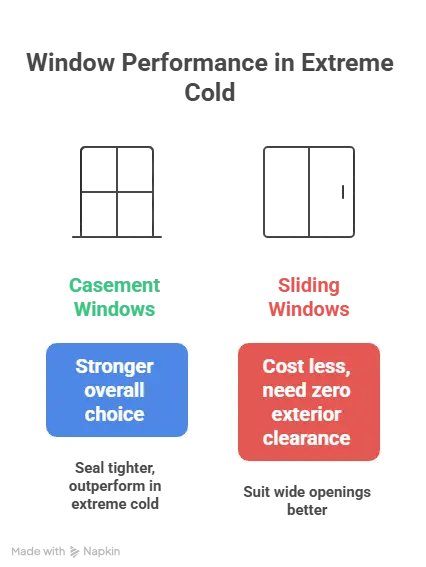
Casement windows seal tighter, cost more upfront, and outperform in extreme cold. Sliding windows cost less, need zero exterior clearance, and suit wide openings better. For Winnipeg homes facing -35°C winters, casement windows are the stronger overall choice.
That said, sliding windows earn their place, too. In a city where your furnace runs for six months straight and every heating dollar matters, choosing the right window for the right room is not a style decision. It is a practical one. Read on to find exactly what separates casement vs sliding windows, and which one belongs in every room of your home.
What Is a Casement Window?
A casement window is a side-hinged window that opens outward by turning a crank handle at the base.
When closed, the sash presses against the frame on all four sides, creating a compression seal. This is what makes casement windows genuinely airtight. That seal is also why homeowners across Winnipeg stop losing heat through their frames on brutally cold winter nights.
It blocks cold air, wind pressure, and outside noise right at the frame. Casement windows open to a full 90 degrees, too, giving you 100% of the window opening as ventilation. If your kitchen gets stuffy or your bedroom feels stale in summer, that full opening makes a real difference.
How Casement Windows Work?
A casement window works with a simple crank mechanism at the bottom of the frame. When you turn the handle, an internal gear system turns that rotation into a pushing motion.
This motion moves an operating arm attached to the sash. The arm pushes the window outward on its side hinges until it opens wide, usually around 90 degrees.
When you turn the crank back, the arm pulls the sash closed again. Once shut, a multi-point locking system secures the sash tightly against the frame on all sides, creating a strong airtight seal. All can be possible when you are installing it through professional casement window services.
What Is a Sliding Window?
A sliding window opens side to side instead of swinging out. One or more sashes glide smoothly along a built-in track. No crank, no hinges, just a simple horizontal motion.
Each sash moves on small rollers inside the track frame, so you can open it with one hand. A weatherstripping seal runs along the track edges, blocking drafts and moisture from entering. Since sliding windows never swing outward, they need zero exterior clearance.
That makes them a smart choice for Winnipeg basements, narrow walkways, or rooms facing tight outdoor spaces. They also handle wide horizontal openings naturally. If you want clean sightlines and effortless operation across a larger wall, a sliding window handles it better than most.
Read More: What Are Low-E Windows? Pros, Cost & Lifespan Explained
How Sliding Windows Work?
The frame holds two sashes, one fixed, one movable. Small nylon rollers sit at the base of the movable sash. Those rollers carry the sash along the bottom track channel when you slide it.
A top guide rail runs parallel above, keeping the sash square and stable throughout its travel. When you push it back to the closed position, the latch mechanism locks it firmly in place against the frame.
Casement vs Sliding Windows: Full Head-to-Head Comparison

1. Energy Efficiency
Casement windows are among the most energy-efficient options for Canadian homes. Their tight compression seal greatly reduces air leakage, which helps keep indoor heat from escaping during harsh winters.
Sliding windows rely on weatherstripping inside a track system so the sash can move freely. Because of this, they let in slightly more air, which can be noticeable in higher heating costs during cold Winnipeg winters.
2. Ventilation
Casement windows use 100% of the frame opening for airflow. The outward-swinging sash physically redirects incoming air into your room, so you get full, controlled ventilation every time you open it.
Sliding windows only use 50% of the frame opening because one sash sits permanently fixed on the track channel. That blocked half is why your Winnipeg bedroom still feels warm at night, even with the window wide open.
Read More: Soundproof Windows: Everything You Need to Know Before Buying
3. Cost (Upfront)
Casement windows run $350–$900 per unit installed. Each one carries a crank mechanism, roto-gear, operating arm, and multi-point locking system — four precision components that directly drive that higher price tag.
Sliding windows run $300–$800 per unit installed. Replace 12 windows in your Winnipeg home, and that per-window difference saves you $600–$1,200 upfront money you keep through expert window replacement day and beyond.
3. Ease of Use
The crank handle sits at the base of the frame, so your operating mechanism stays within reach even above a deep kitchen sink or high countertop. You turn the crank, and the sash opens exactly as far as you want.
Sliding windows need no crank, no gear, no mechanism at all. Push the sash along the track channel, and it opens. If your parent or grandparent in a River Heights or St. Vital home struggles with grip strength, that one-hand push makes all the difference daily.
4. Maintenance
Casement windows need annual lubrication on three points: the hinges, crank mechanism, and operating arm. Skip that, and the roto-gear strips quietly over time until one morning your window simply will not open.
Sliding windows have fewer parts, so upkeep is lighter. But condensation on your windows in winter drives ice deep into the track channel, and Transcona street grit adds to that buildup fast. Let it accumulate, and your sash jams solid on the coldest morning of the year.
Read More: How to Stop Water From Damaging Basement Windows
5. Security
The multi-point locking system pulls the sash into the frame at several points around the perimeter simultaneously. Every lock point must be defeated at once, leaving no single weak spot that an intruder can target from outside.
Standard sliding windows are secured with a single meeting rail latch, one lock point on the entire frame. Without anti-lift pins installed, the sash can also be physically lifted off the track channel from outside your home. For ground-floor windows in busy Winnipeg neighbourhoods, that matters.
6. Noise Reduction
The compression seal on a casement window closes every air gap around all four sides of the frame. Sound travels through air, so eliminating the gap and you cut exterior noise entering your room significantly.
Sliding windows rely on pile weatherstripping along the track channel, which must allow air movement by design. That gap lets sound through. If your bedroom window in Fort Garry or St. Boniface faces a busy road, you will notice the difference on any night
7. Aesthetics
Casement windows have a single unbroken glass panel with no dividing frame rail running through the middle. That clean, unobstructed view gives your home a refined, classic look that works whether your Winnipeg home was built in the 1940s or last year.
Sliding windows have a visible frame rail where the two sashes overlap at the centre. If your home has wide walls and a modern exterior, that horizontal frame line fits your architecture cleanly without competing with it.
8. Resale Value
Casement windows deliver a stronger return on investment than sliding windows. Their tighter compression seal, superior energy ratings, and classic curb appeal directly influence what buyers notice and what they will pay for a Winnipeg home.
Sliding windows still add real resale value, particularly in modern homes where buyers prioritize clean lines and low maintenance. If your budget is tight now, sliding windows let you upgrade affordably while still improving your home’s appeal on sale day.
9. Space Requirements
Casement windows need 24–36 inches of clear space outside to open fully on their side hinges. If a deck railing, walkway, or fence sits right outside that window, that outward swing turns into a real daily frustration.
Sliding windows need zero space outside because the sash travels only within its own frame track. In close-built Winnipeg neighbourhoods where homes sit near the property line, a single slider window fits neatly where a casement simply cannot.
What are the Pros and Cons of Casement Windows?
Pros
- Airtight compression seal on all sides
- Lowest air leakage rate available
- 100% frame opening for airflow
- Easy crank operation above countertops
- Stronger multi-point locking system
- No dividing rail blocking your view
- Opens to catch airflow directly
- Best fit for Winnipeg winters
Cons
- Costs 15–20% more upfront
- Needs 24–36 inches of exterior clearance
- Annual crank and hinge lubrication is required
- Roto-gear can strip over time
- Cannot be installed near walkways or fences
- Not ideal for wide horizontal openings
What are The Pros & Cons of Sliding Windows
Pros
- No exterior clearance needed
- Lower upfront cost per window
- Zero mechanism to learn or operate
- Suits wide horizontal wall openings
- Ideal for basements and tight spaces
- Effortless for seniors and children
- Fewer parts mean simpler maintenance
- Modern, clean horizontal profile
Cons
- Only 50% of the frame opens
- Weatherstripping is less airtight than a casement
- A single latch is vulnerable without anti-lift pins
- Track channel collects ice and grit
- More sound enters through track gaps
- Weaker long-term energy performance
Read More: Double Pane vs Triple Pane Windows: A Detailed Comparison
Casement vs. Sliding Windows: Which One Is Right for Each Room in Your Winnipeg Home?
The right window does not just depend on what you like. It depends on what that room actually demands every single day.
| Room | Best Choice | Why |
| Kitchen | Casement | Crank handle at the base opens with one hand over the sink. Full-swing clears your cooking steam and odours fast. |
| Bedroom | Casement | Compression seal keeps street noise and cold air out while you sleep. Full-swing gives you strong airflow on warm Winnipeg nights. |
| Basement | Casement or Sliding | Casement gives better ventilation and egress clearance. Sliding needs no exterior swing — the right call for tight window wells and budget-conscious installs. |
| Bathroom | Casement | Full 90-degree opening pulls moisture and steam out of your bathroom faster than a 50% slider ever can. |
| Living Room | Sliding (often) | Wide horizontal wall suits a double slider window naturally. Clean frame line keeps your full view completely open. |
| Near Walkway / Deck / Fence | Sliding | Zero exterior clearance needed. The sash stays inside the frame track; nothing swings into your space. |
Note:
Older homes in areas like Transcona, River Heights, and St. Vital typically have original or once-replaced frames that have shifted from clay soil movement.
Casement windows suit narrow, tall openings common in pre-1980 builds. Professional installation in Winnipeg ensures the new frame is properly squared, even where the original opening has moved.
Still Not Sure Which Window Is Right for Your Home?
Casement windows are the better investment for most Winnipeg homes. They seal tighter, last longer, and save more on heating bills over time. But sliding windows have real advantages in basements, wide openings, and tight exterior spaces. The smartest approach is using both, each type placed in the room it actually serves best.
At SmartTech Windows and Doors, we do a free room-by-room walkthrough of your home across Winnipeg. No pressure, no obligation. Book your free quote today and get the right window in every room, first time.
Read More: Bay vs Bow Windows: What Every Homeowner Must Know
Frequently Asked Questions
Are casement windows more energy efficient than sliding windows?
Yes. Casement windows produce an air leakage rate of just 0.0–0.1 L/s·m², according to Natural Resources Canada testing. Sliding windows run 0.2–0.3 L/s·m² because their weatherstripping seal must stay flexible to allow the sash to move.
Double pane vs triple pane windows, which should I choose?
Double-pane windows reach R-3 to R-5 insulation. Triple-pane windows reach R-6 to R-9. In a city where temperatures stay below freezing for over 113 days a year, that extra insulation layer is not a luxury — it is the practical choice.
What does the Efficiency Manitoba window rebate cover?
Efficiency Manitoba gives you $100 back on each ENERGY STAR certified triple-pane window you install. Double-pane windows do not qualify. Apply within 90 days of your installation invoice through the official Efficiency Manitoba program.